
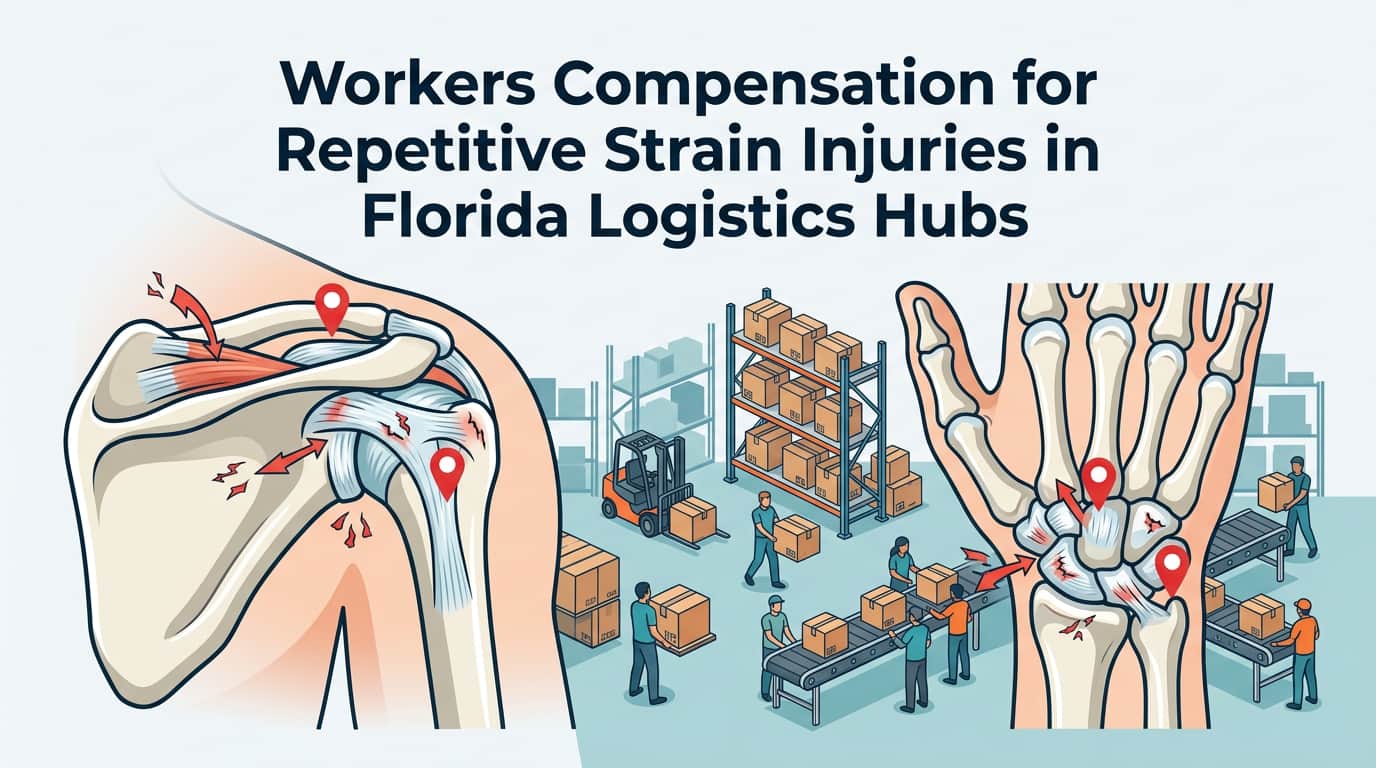
Florida's logistics sector is massive. From the Port of Miami to the sprawling distribution centers along I-4 near Orlando, warehouse workers handle thousands of repetitive tasks every single shift. Scan a barcode. Lift a box. Repeat. Do that for eight hours a day, five days a week, and your body starts to pay a price you never agreed to.
If you work in a Florida warehouse and you're dealing with wrist pain, a sore lower back, or aching shoulders, you may already qualify for workers' compensation benefits. You don't need to have been crushed by a forklift or fallen from a shelf. A slow-building injury from repetitive motion counts too.
Not sure where you stand? Call Adam Ross Littman, Attorneys at Law at (407) 644-9670 for a free consultation. Our team has been helping injured workers throughout Central Florida since 2001, and we'll give you a straight answer about what your claim is worth.
Yes. Florida workers' compensation law covers repetitive strain injuries (RSIs), but they're treated differently than single-accident injuries. Under Florida Statute 440, RSIs qualify as "occupational diseases," which means you must show that the injury arose out of and in the course of your employment, and that your work conditions were the major contributing cause, accounting for more than 50% of the injury. That's a higher burden than many workers expect, and it's one reason these claims get denied more often than straightforward accident claims.
The law also has strict reporting deadlines. You generally have 30 days from the date you knew, or should have known, your injury was work-related to report it to your employer. Miss that window, and you risk losing your right to benefits entirely.
Florida's logistics industry is one of the fastest-growing in the Southeast. The Port of Jacksonville processes over 1 million vehicles annually. PortMiami handles millions of shipping containers. Closer to home, the distribution corridors along Interstate 4 between Orlando and Lakeland host dozens of major fulfillment and warehousing facilities, many of them operating 24 hours a day.
Workers in these environments spend entire shifts performing the same physical movements over and over. Order pickers walk 10 to 15 miles per shift. Loading dock workers repeatedly lift boxes weighing 30 to 50 pounds. Scanner operators flex and extend their wrists hundreds of times per hour. Over weeks and months, these movements quietly damage tendons, nerves, and joints. By the time a worker feels real pain, the injury has often been building for a long time.
We've handled RSI claims from workers at facilities throughout Orange, Osceola, and Polk counties, and the pattern we see is consistent: workers wait too long to report symptoms because they assume the pain will go away on its own. It rarely does.
The three RSIs we see most often in Florida logistics workers are carpal tunnel syndrome, tendonitis, and lower back strain.
Carpal tunnel syndrome develops when the median nerve running through the wrist becomes compressed, usually from sustained or repetitive gripping, typing, or scanning motions. Symptoms include numbness, tingling, and weakness in the hand. Left untreated, it can cause permanent nerve damage. Surgical treatment typically costs between $6,000 and $11,000 per hand, and recovery takes 4 to 6 weeks minimum.
Tendonitis is inflammation of the tendons, most commonly in the shoulder, elbow, or wrist. Workers who perform overhead reaching or repetitive lifting are especially vulnerable. Chronic tendonitis may require physical therapy over 8 to 12 weeks, and in severe cases, surgical intervention.
Lower back strain is the most reported musculoskeletal injury among warehouse workers nationwide. Florida's workers' compensation system treats lower back claims carefully, especially when there's a pre-existing condition involved. Your employer's insurer will look closely at your medical history. That's exactly why having a qualified workers' compensation attorney in your corner matters from day one.
Florida Statute 440 requires workers filing repetitive motion claims to provide "clear and convincing evidence" that the injury was work-related. Here's what that means in practice.
Get medical attention immediately. See a doctor as soon as symptoms begin. Make sure you describe your job duties in detail so the physician can connect your diagnosis to your work. A medical record that says "wrist pain" without any reference to your job tasks is much harder to use in a claim than one that says "carpal tunnel consistent with repetitive scanning duties."
Report the injury to your employer in writing. A verbal report may not be enough. Put it in writing, note the date, and keep a copy.
Keep a symptom log. Write down when your symptoms started, how they've progressed, and which job tasks make them worse. Dates, times, and specific details matter.
Request all records. Ask for copies of your employer's injury report, your medical records, and any communications from the workers' comp insurer. You have a right to these documents.
Insurers routinely challenge RSI claims on the grounds that the injury could have developed outside of work. A treating physician who understands Florida's "major contributing cause" standard and can document how your specific job duties produced the injury is one of your strongest assets.
For a single-accident claim with clear documentation, some workers manage without legal help. For an RSI claim, the answer is almost always yes.
RSI claims get denied or underpaid at a much higher rate than other workers' comp claims. Employers and their insurers have experienced legal teams specifically trained to challenge occupational disease claims. If your claim is disputed, it may proceed to the Florida Division of Administrative Hearings (DOAH), where a judge of compensation claims will hear the evidence. That process can take 18 to 24 months without proper legal representation, and the procedural requirements are not forgiving.
A local evaluation also matters. Physicians familiar with the physical demands of Florida's logistics industry, and attorneys who understand the claims landscape around Orange County and the I-4 corridor, can make a real difference in the outcome of your case.
Our firm has represented workers throughout Central Florida, including those working near the MetroWest and Dr. Phillips distribution corridors, and we understand how Florida's workers' comp courts view these cases. If you've suffered a personal injury on the job, or you're unsure whether your situation qualifies, we're ready to review your claim at no cost to you.
An RSI can sideline you for months, run up medical bills in the thousands, and leave you wondering how to pay for groceries while you recover. You have rights under Florida law, and you don't have to sort through them alone.
Report your injury today. See a doctor who will document the connection to your job. And then call a lawyer who knows workers' compensation in Orlando, Florida inside and out.
Contact Adam Ross Littman, Attorneys at Law, at (407) 644-9670. We offer free consultations, we work on a contingency fee basis, and we've been fighting for injured Florida workers for over two decades. Your recovery comes first.